%20--%3e%3cpath%20d='M59.1,199.2c1.4,12.4,17,19.5,35.9,19.5s25.9-1.8,37.8-5.5l6.6,35.7c-15.9,6.2-34.7,8.6-52.6,8.6-49.8,0-77.8-28.1-77.8-75.4s24.3-80.1,73.5-80.1,64.7,31.6,64.7,75.4-.9,17.9-1.8,21.8H59.1ZM99.2,163.4c0-10.5-3.6-26.3-19.2-26.3s-20.6,15.7-21.2,26.3h40.5Z'%20fill='%23231f20'/%3e%3cpath%20d='M203.7,105l13.8,62.4c2.8,12.8,4.8,25,6.7,38.1h.9c1.8-13.6,3.7-24.8,6.3-38.1l13-62.4h54.2l-50.2,149.7h-51.7l-49.8-149.7h56.8Z'%20fill='%23231f20'/%3e%3cpath%20d='M347,199.2c1.4,12.4,17,19.5,35.9,19.5s25.9-1.8,37.8-5.5l6.6,35.7c-15.9,6.2-34.7,8.6-52.6,8.6-49.8,0-77.8-28.1-77.8-75.4s24.3-80.1,73.5-80.1,64.7,31.6,64.7,75.4-.9,17.9-1.8,21.8h-86.2ZM387,163.4c0-10.5-3.6-26.3-19.2-26.3s-20.6,15.7-21.2,26.3h40.5Z'%20fill='%23231f20'/%3e%3cpath%20d='M451.4,155c0-18.7-.6-35.8-1.2-50h45.3l2.4,18.5h.9c6.3-9,20.3-21.6,42.6-21.6,33.9,0,50.2,24.4,50.2,62.8v90h-52.6v-84.8c0-15.1-5-25.2-17-25.2s-13.6,6.1-16.2,11.9c-1.2,2.7-1.8,7.3-1.8,11.9v86.3h-52.6v-99.7Z'%20fill='%23231f20'/%3e%3cpath%20d='M672.2,63.1v41.9h30.6v38h-30.6v48c0,17.4,5.1,23.7,16.7,23.7s9.1-.5,12.4-1.1v40.2c-6.2,2-17.7,3.7-31.1,3.7s-27.7-4.8-35.7-12.5c-9.1-8.9-14-22.8-14-46.2v-55.9h-18.1v-38h18.1v-30.3l51.6-11.6Z'%20fill='%23231f20'/%3e%3cpath%20d='M773.7,49.6v205.1h-52.6V49.6h52.6Z'%20fill='%23231f20'/%3e%3cpath%20d='M964.1,291.7c-26.4-8.6-48.4-18.3-74.1-30.2-4.7-2.3-9.5-3.4-13.5-3.8-44.5-2.4-82.8-38.1-82.8-104.6s33.3-106.6,93.1-106.6,89.2,53,89.2,102.5-17.4,77.6-39.6,89.2v1.4c13.4,4.8,28.7,8.4,43.5,12.3l-15.8,39.8ZM920.6,151.3c0-36.6-12.7-62.1-35.5-62.1s-36.2,25.8-36,62.5c-.3,38.6,13.4,63.3,36,63.3s35.5-24.7,35.5-63.8Z'%20fill='%23231f20'/%3e%3c/svg%3e)
 Türkçe
 English
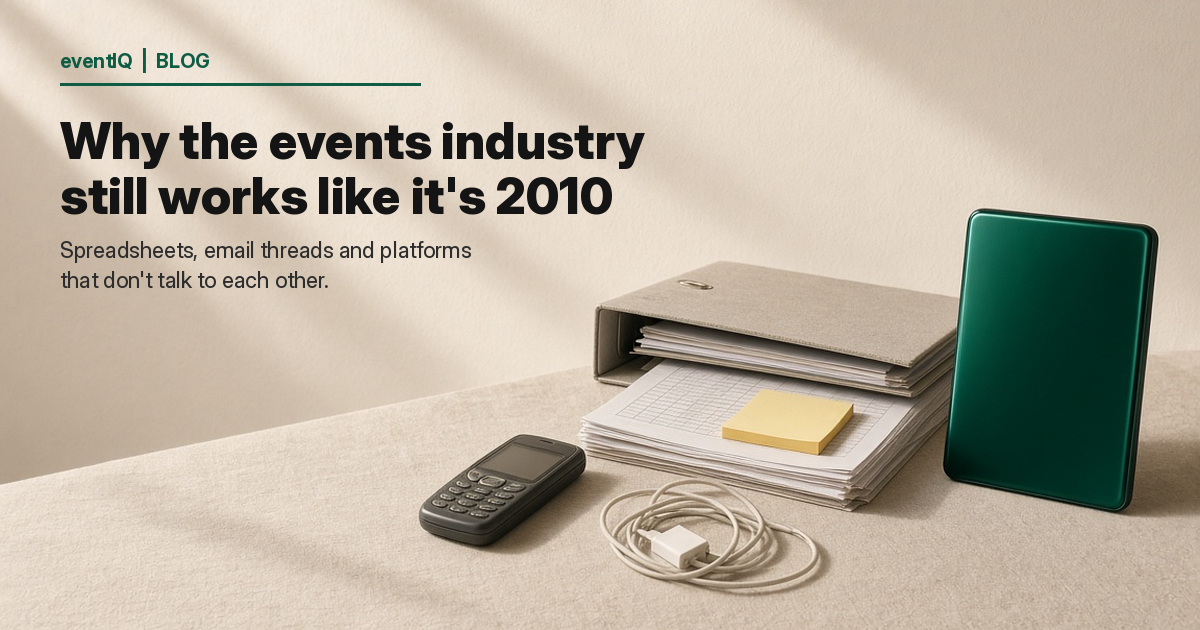
Why does the events industry still work like it is 2010?
Event experiences have moved on; the operations behind them often haven't. Why change is slow, and a manageable first step for event companies.
Burcu Çetin
Contents
- The next deadline keeps winning
- Skilled people keep weak processes alive
- More software has created more places to check
- Leadership cannot delegate the entire transition to the software
- Teams follow what management actually requires
- Every event is different, but many workflows repeat
- Technology providers also have work to do
- AI raises the value of fixing the foundations
- A transition needs a manageable first step
- Moving beyond 2010 means changing everyday behaviour
- References
A rooming list changes in WhatsApp. Someone updates an Excel file. Someone else emails an older version to the hotel. The project manager calls to find out which one is correct.
Meanwhile, the event itself has an impressive stage, a sophisticated visual identity and a programme built around the future.
This is a useful picture of the gap in our industry: the experience on display can be far more advanced than the operations behind it.
Event professionals deliver extraordinary work under difficult conditions. Yet too much of that delivery still depends on scattered information, manual follow-ups and experienced people remembering what everyone else has forgotten.
Why has this been so difficult to change?
Part of the answer is technology. Much of it is leadership, economics and company culture.
The next deadline keeps winning
An event has a fixed opening time. The doors will open whether your internal processes are ready or not.
When a supplier changes a price, a client revises the brief or a guest needs a different room, teams use the fastest familiar route. Another message. Another spreadsheet. Another phone call.
Each choice can make sense in the moment. Together, they create a way of working that becomes difficult to replace.
Process improvement gets postponed until after the event. Then the next project begins, carrying the same habits forward.
Learning a better system has an immediate, visible cost in time. Continuing with the old process spreads its cost across hundreds of small interruptions. Those interruptions become so familiar that people stop counting them.
Skilled people keep weak processes alive
Every event company recognises the person who knows everything.
They remember what the client agreed to. They know which supplier quote is current. They can explain the difference between the approved budget and the file someone just shared.
Their experience is valuable. But when that person becomes the main way information moves through the company, the organisation becomes dependent on their availability.
A successful event can hide this weakness. The client sees a smooth experience; the team knows how much chasing, overtime and last-minute reconciliation it took to produce it.
If success is measured only by whether the event happened and the client was happy, the business has little reason to examine the effort underneath.
The same people keep rescuing the same processes.
More software has created more places to check
The industry has adopted plenty of digital tools. The question is how well those tools work together.
Forrester’s 2025 B2B events research found that 28% of the largest organisations had deployed six or more event technology platforms. Only one in five organisations had fully integrated its primary event platform into its broader sales and marketing technology stack.[1]
That research concerns B2B event technology, but it illustrates a problem worth examining across event operations: buying tools does not automatically connect the work.
A company might have a registration platform, a budgeting tool, a task manager and a shared drive. Employees can still spend their day copying information between them and asking colleagues what has changed.
A useful measure of progress is how often someone must enter, explain or reconcile the same information.
When those repetitions remain, the administrative burden remains too.
Leadership cannot delegate the entire transition to the software
In our work with event businesses in Turkey, we encounter another barrier: owners and managers may understand that their companies need to modernise without knowing how to lead that change.
This is an observation from our experience, rather than a claim about every Turkish business or a problem unique to Turkey.
An owner can be excellent at client relationships, negotiations and event delivery while having limited experience evaluating technology or changing internal workflows.
That makes investment difficult. The subscription, implementation cost and learning time are visible. The cost of fragmented information is harder to calculate.
Without a clear way to assess the return, the decision can become a comparison between the price of software and a familiar process that appears to cost nothing.
Even when management approves the investment, a second challenge begins: making the new way of working part of everyday operations.
Buying a platform does not answer who will own the transition, which workflow will change first, what employees should stop doing or how managers will check progress.
Those are management decisions. They need an owner inside the business.
Teams follow what management actually requires
“We are too busy to learn a new system” is a familiar response.
Sometimes it reflects real workload pressure. Sometimes employees have seen previous tools introduced enthusiastically and then abandoned. Sometimes the new system asks them to do their existing work twice.
It is tempting to describe all of this as resistance to change. That explanation leaves too much unanswered.
What happens when someone updates the platform, but their manager asks for a separate spreadsheet? What happens when tasks are assigned in the new system, but urgent instructions continue to arrive through messages? What happens when a director makes decisions using information that was never recorded?
Employees quickly learn which channel matters.
If management accepts every old route, adopting the new one becomes an extra responsibility. Busy teams will prioritise the route that gets the fastest response.
Clear expectations matter. A manager needs to be able to say: “For this project, all task assignments and status updates will be recorded here. Our weekly review will use that information.”
Then the manager must follow the same rule.
Pressure from leadership can establish a standard. Sustained adoption also needs time to learn, practical support and a system that makes the work easier. Requiring usage while maintaining duplicate processes creates frustration.
Every event is different, but many workflows repeat
Event teams rightly take pride in responding to unusual requirements. Clients, venues, audiences and creative concepts vary.
Yet many operational steps recur: requesting proposals, comparing suppliers, approving spending, assigning tasks, revising accommodation lists and tracking changes.
When every project is treated as entirely exceptional, the company loses opportunities to improve these recurring steps.
A repeatable approval process does not limit a creative concept. A reliable rooming-list workflow does not prevent personalised service. Clear task ownership gives people more room to solve the parts of the project that actually require judgement.
The challenge is deciding where consistency helps, then making that consistency easy to maintain.
Technology providers also have work to do
Software companies cannot explain every failed implementation by saying the customer resisted change.
A confusing interface, excessive setup and long training sessions all raise the effort required to adopt a product. Employees arrive with expectations shaped by the applications they use every day. Business software has to earn their confidence through clarity and usefulness.
Implementation also needs to be concrete.
“Here are all our features” gives a busy team a new subject to study. “Here is how your next budget approval will work, who approves it and where you will see its status” gives them a task they can complete.
Providers should make the first useful workflow easy to start, explain responsibilities clearly and help customers see progress. Leadership inside the customer’s company must make that workflow part of how the team operates.
Both sides have responsibilities.
AI raises the value of fixing the foundations
AI can help teams extract requirements from a brief, compare proposals, identify inconsistencies or retrieve relevant information from previous projects.
Its usefulness depends on the information available to it.
If the approved price is in an email, the latest quantity is in a spreadsheet and a key exception exists only in a phone conversation, an AI assistant may have an incomplete view.
Giving it more documents does not, by itself, tell it which version is approved or who has authority to change it.
Companies need ways to keep information current, record decisions and distinguish proposals from commitments. Human review remains necessary where errors would affect clients, suppliers or spending.
AI makes these foundations more valuable because better information can support more useful assistance across the business.
A transition needs a manageable first step
A busy event company needs a change it can carry out during real work.
Start with one recurring problem: budget approvals, supplier comparisons or task follow-ups. Choose a live project and give someone responsibility for the transition.
Define where the work will happen, who updates it, who reviews it and which duplicate steps can end. Set aside time for people to practise. Managers should use the same information in their own reviews and decisions.
Then examine the result. Did approvals become faster? Did the team spend less time chasing updates? Were there fewer version errors?
Use that experience to improve the workflow before expanding it.
This requires management attention, but it gives that attention a clear scope and a result to assess.
Moving beyond 2010 means changing everyday behaviour
The events industry has no shortage of creativity, resourcefulness or ambition. Those strengths deserve operations that support them.
At eventIQ, we see management, decision-making and attendee experience as connected parts of that work. Reliable project information helps managers act with confidence. Clear workflows reduce unnecessary coordination. Better operations give teams more time to focus on clients and participants.
Progress becomes visible in ordinary moments: a manager reviews the current budget without requesting another export; a team member can see who owns the next action; a hotel receives a clearly approved accommodation update.
An event company starts moving forward when those moments become routine.
References
[1] Forrester, Q1 2025 State of B2B Events survey. Conrad Mills and Hannah Jachim, "Events Are Under Pressure: Six Findings From Forrester's Q1 2025 State Of B2B Events Survey", Forrester blog, 23 May 2025. https://www.forrester.com/blogs/events-are-under-pressure-6-findings-from-forresters-q1-2025-state-of-b2b-events-survey/
Get started
See eventIQ in action
A tailored walkthrough of the Experience Engine and Business Engine, with clear next steps if it's a fit, and an honest no if it isn't.